ITRS named a Visionary in the 2025 Gartner® Magic Quadrant™ for Digital Experience Monitoring.

What’s new

See the latest features and product updates in Uptrends
View the API changelog and reported issues in the Incident log.

Submit a feature request

UPDATE

FEB 2025

#Maintenance periods overview updates

Operators that have Edit settings monitor permissions for at least one monitor can now access the Maintenance periods overview page. Previously, only administrators had access to this page.

Operators can view, Clean up, or Delete all maintenance periods for the monitors they have Edit settings permissions for.

UPDATE

JAN 2025

#Introducing Private Locations Permissions

Private locations allow you to perform monitor checks (internally) within your server and firewall instead of the default Uptrends public checkpoints.

By default, all operators have access to all private checkpoint locations. Operators can create, update, disable, and delete a checkpoint anytime. It is essential to manage the level of visibility and permissions among operators.

With the new Manage Private Locations feature, you can set permission rights for specific operators and operator groups:

  • Create — allows operators and operator groups to access and create private locations.
  • Edit — allows operators and operator groups to access, edit, and delete private locations.
  • Use — allows operators and operator groups to select the private location as a checkpoint to run monitors

If an operator has any of the permissions above, the private location will be visible in the Checkpoints tab of a monitor and accessible in the Private locations menu.

Private Locations Permissions GIF

UPDATE

JAN 2025

#Introducing Clear browser cache in transaction monitors

Uptrends transaction monitors always open a browser to simulate user activities to check the performance of your website. The browser starts without cached data, and later stores cache to temporarily store website resources to speed up the loading process.

If you want to compare the behavior of your e-commerce site when loading items in the shopping cart for existing users (with cached data) compared to new visitors (without cached data), we recommend clearing the browser cache.

With the new Clear browser cache action in transaction monitors, you can now empty the browser cache to reload page elements directly from the server instead of the browser cache. This feature helps you check the website’s first-time visit performance and ensures that UI displays (such as images, text, and other front-end elements) are loaded correctly. This action doesn’t cost any transaction credits. Use this to enhance your monitoring needs. For more information, refer to the Transaction step editor.

Clear Browser Cache GIF

UPDATE

JAN 2025

#Custom metrics now show the minimum and maximum metric values

The Custom metrics in Multi-step API monitors (MSA) let you create custom metric variables to collect and store numerical data from an API response step.

These metric variables can be displayed through a Custom metrics chart, showing the metric’s trends over time. Before, the chart only shows the custom metric’s average value (high points) as a data point. Now, the custom metric’s minimum and maximum values are also displayed. Note that existing MSA monitors with custom metrics data from 1 November 2024 onward will be reflected in your Custom metrics chart.

Custom metrics chart with minimum and maximum metric values

UPDATE

JAN 2025

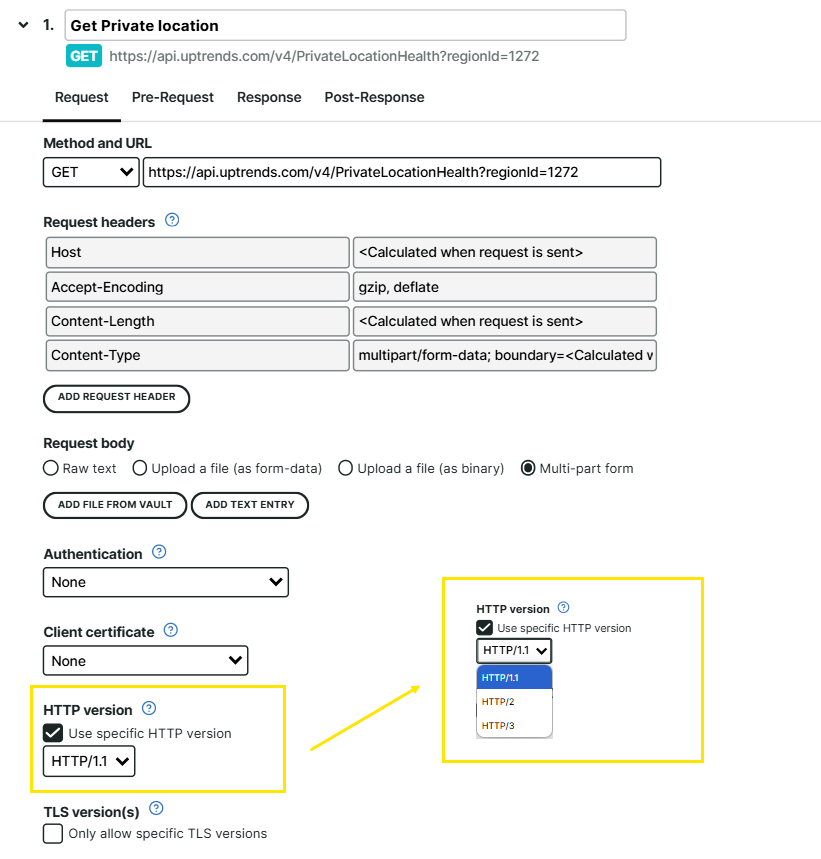
#Support for the Multi-part form is now available on MSA monitors

When setting up a Multi-step API monitor, you can specify a payload (data being sent) as part of a request definition. Before, Uptrends only supported sending one type of content at the same time, even though the HTTP protocol does allow multiple parts to be sent. For example, sending some raw text as well as a binary file as part of a single API call.

With the new Multi-part form option, you can now include multiple types of content in the request body of your MSA steps. This option automatically sets the Content-Type request header to multipart/form-data and lets you specify multiple contents in different types. These types can be plain texts entries or files retrieved from the Vault.

MSA Multi-part form
By using the Uptrends website, you consent to the use of cookies in accordance with our Cookie Policy.